
The use of drones in farming has transformed traditional agricultural practices into smart, data-driven operations. From crop monitoring to precision spraying, drones are helping farmers increase productivity while reducing costs and environmental impact. Understanding the Agriculture Drone Advantages is essential for farmers, agribusiness owners, and policymakers who want to adopt sustainable and efficient farming methods.
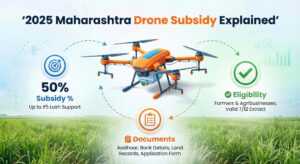
This article explains how agricultural drones work, their key benefits, real-world applications, and why they are becoming an essential tool in modern agriculture. Click to Learn How to Get 50% Subsidy on Agriculture Drones in India
Agricultural drones are unmanned aerial vehicles (UAVs) equipped with advanced sensors, cameras, and spraying systems. They are designed to collect real-time field data, analyze crop health, and perform tasks such as spraying fertilizers or pesticides with high precision. Here is official government information on drone subsidy schemes.
The growing adoption of these systems highlights the Agriculture Drone Advantages in improving farm efficiency and decision-making accuracy.
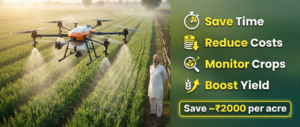
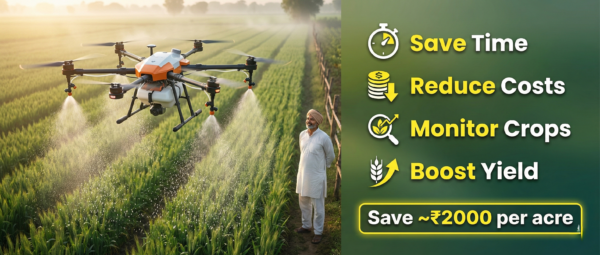
Traditional farming methods rely heavily on manual observation and uniform treatment of crops. This often leads to resource wastage and delayed problem detection. Drones solve these issues by offering:
These capabilities clearly demonstrate the Agriculture Drone Advantages in reducing operational challenges faced by farmers. Top Advantages of Payload Drones in Modern Agriculture.
Drones capture high-resolution images and multispectral data that reveal plant stress, nutrient deficiencies, and pest attacks. This allows farmers to take corrective action early.
One of the strongest Agriculture Drone Advantages is the ability to detect crop issues before they become visible to the human eye.
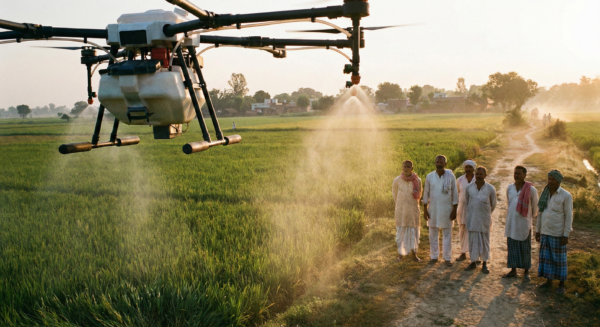
Agricultural drones spray chemicals only where needed, reducing overuse and minimizing environmental damage. Variable-rate spraying ensures uniform application.
This targeted approach is among the most practical Agriculture Drone Advantages for cost-saving and sustainability.
By combining data analytics with precision treatment, farmers can optimize irrigation, fertilization, and pest control. This leads to healthier crops and higher yields.
Higher output with fewer resources is a clear example of Agriculture Drone Advantages in action.
A drone can survey or spray several acres in minutes, a task that would take hours or days manually. This reduces dependence on labor, especially during peak seasons.
Labor efficiency is one of the most appreciated Agriculture Drone Advantages among large-scale farmers.
Thermal sensors in drones identify dry zones and over-irrigated areas. Farmers can adjust water distribution accordingly.
Water conservation is a critical Agriculture Drone Advantages, particularly in drought-prone regions.
NDVI and multispectral imaging help assess plant vitality and growth patterns throughout the season.
Drones generate accurate 3D maps, helping farmers plan planting patterns and drainage systems.
Some drones are used to track livestock movement and monitor large grazing areas efficiently.
Each application reinforces the long-term Agriculture Drone Advantages for both crop and livestock farming.
| Agricultural Task | Traditional Method | Drone-Based Approach | Key Advantage |
|---|---|---|---|
| Crop Monitoring | Manual field inspection | Aerial imaging & analytics | Early issue detection |
| Pesticide Spraying | Tractor or manual spraying | Precision drone spraying | Reduced chemical use |
| Irrigation Planning | Visual estimation | Thermal & moisture mapping | Water efficiency |
| Yield Prediction | Historical guesswork | Data-driven analysis | Accurate forecasting |
| Labor Requirement | High | Low | Time & cost savings |
This table clearly highlights real-world Agriculture Drone Advantages across common farming operations.
In most countries, including India, agricultural drone usage is regulated by aviation authorities. Farmers must follow guidelines related to altitude, no-fly zones, and pilot certification.
When operated correctly, drones are safe, reliable, and compliant, further strengthening the trust in Agriculture Drone Advantages.
While the initial investment in agricultural drones may seem high, the long-term savings in labor, water, fertilizers, and crop losses often outweigh the cost within a few seasons.
The return on investment is another major Agriculture Drone Advantages for commercial farming operations.
With AI integration, autonomous flight planning, and real-time analytics, drones will play a central role in precision farming. As technology advances, the Agriculture Drone Advantages will continue to expand, making farming smarter and more resilient.
Drones improve crop monitoring, reduce input costs, save time, and increase yield through precision farming.
They provide real-time field data, enable targeted spraying, and support better decision-making.
Initial costs vary, but long-term savings make them cost-effective for most farms.
Yes, by identifying problems early and optimizing inputs, drones help improve productivity.
Yes, drones use controlled and precise spraying methods that protect crops and soil health.
Mapping drones, spraying drones, and surveillance drones are commonly used.
Basic training or certified operators are recommended for safe and legal operation.
Drone data is highly accurate due to advanced sensors and AI-based analytics.
Yes, shared services and rental models make drones accessible to small farmers.
They combine automation, data intelligence, and sustainability, offering long-term efficiency.